{`A lead dev's quality collapse, facing the client head-on, and rethinking the whole business model.`}
Our First Hell Gate Since Founding Potential
Lukas
Jun 4th 26
11 min Read
For the first time since founding Potential, I hit a real crisis. A project whose quality had collapsed under its lead developer, facing the client head-on, and the bigger question that crisis dragged out into the open — a question about the agency model itself.
It's been a while since I wrote. After meeting YR last week, an uneasy sense set in that I had to make time to think things through. So let's rewind three months.
February: the problems had piled up
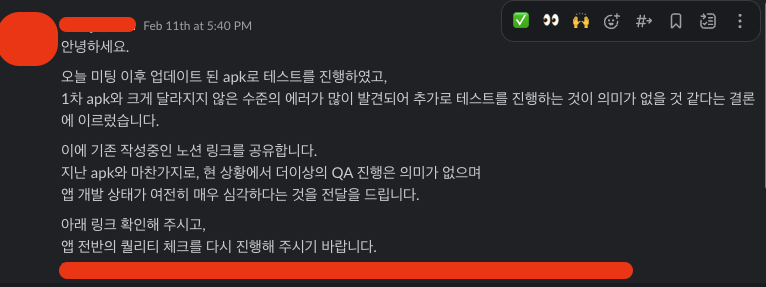
In February, Potential had 5–6 projects running and the team was growing fast. Unlike two years ago, when we were under ten people, I could no longer be involved in the details of every project. And then I got the message.
What had gone wrong? I gathered all the project leads for 1-on-1s, and I went through the code myself, line by line. (It was an Android project — and for the record, I'm not an Android developer.) And there it was: a mountain of problems.
- I'd handed the project to a lead developer I fully trusted, and the quality was a mess.
- The lead developer didn't grasp how serious the situation was.
- My personal creed — never micromanage — was starting to crack.
I was furious at the developer who'd repaid my trust this way. And I felt terrible for the client I'd put in this position. So — how do I fix this? I decided to cool my head and untangle it one piece at a time.
You can't hide behind it. You go straight through
Usually in a situation like this your head runs hot and the stress makes sleep impossible. The urge to fold everything up and hide somewhere was overwhelming — but I know that the worse it gets, the more you have to go straight through it. So I called the client.
"Hello, this is Dongsub Shin, CEO of Potential. First, I'm sorry for putting you through this. What I'm about to tell you will be hard to believe, but I will fix this problem. Please give me a little time."
And starting the next day, I showed up at the client's office in person. That first day, the heavy mood in their office was suffocating — but there was no other way. My employee's mistake is my mistake. So I worked through it, piece by piece. Money you can always make again. But trust, once lost, can't be bought back at any price. Day and night, weekends and weekdays, I pushed through the recovery, the stress piling higher — but slowly, threads of a solution began to appear.
Then came the bombshell. The lead developer who caused all this announced he was quitting. He was going to dump on me on his way out, properly. I couldn't understand his way of thinking at all — but there was nothing to do. Keeping someone like that around long-term would surely have caused problems down the line.
Living through this, I finally understood why the bigger a company gets, the more it shifts toward a system where any member can be replaced at any time. The CEO of a Vietnamese company I met recently said something similar: don't trust your employees too much — set the company up assuming anyone could leave at any moment. (It doesn't fit my leadership style, but still.)
February felt utterly hopeless, but looking back now, there really is no problem that can't be solved. Thanks to the crisis, both the company and I got a lot more solid. The hell gate was resolved, the relationship with that client recovered well, and they even entrusted us with another project. As always — never retreat in a crisis.
What is our company actually accumulating?
Someone reading that episode might say, "Wow, CEO Shin, impressive — you're growing." But I saw it differently. Two precious months that should have driven the company forward had vanished. And a question surfaced: is this the right way to grow a company at all?
The agency model I run has a huge upside and a huge downside. The big upside: you have cash flow from day one, and if you just work diligently and honestly, you can make good money. The fatal downside: its business multiplier is 1, or maybe 1.1 if you're generous.
What's a "business multiplier"?
It's a name I made up over dinner with YR last week, for lack of a better one. The Korean YouTuber Shin Saimdang once explained this idea. There are two kinds of work:
- Type 1) Put in 1 unit of effort, get 1 unit of result.
- Type 2) Put in 1 unit of effort, and the effect compounds to N over the long run.
Type 1 looks like: working a convenience-store shift, running a project-based business like mine, or earning a salary at a job. Type 1 work doesn't return exactly 1 — it carries a small extra multiplier of 1.1–1.2. In our case, for instance, portfolio accumulates and industry reputation builds. Running more projects also accumulates know-how inside the company. But the multiplier is never large.
Type 2 looks like: making investments, creating video content, or running a SaaS business. You put in effort over a fixed period, and the effect pays out over the long run. Think of the company that created Pororo (a Korean kids' character). Researching and building that character took enormous effort. But once it's designed and made, the returns keep coming for years.
By this lens, our company always carries a weakness. With a tiny business multiplier of 1.1 or 1.2, you can't generate big impact. How do we expand from the Type-1 zone into the Type-2 zone? And right then, an opportunity came.
Opportunity 1 — online Korean-language education
I flew to Jeju to meet one of our clients. I've always respected this man: he's past 70, yet runs an online business that actually earns foreign currency. We talked about all sorts of things in his Jeju office, and over sashimi — his treat, thanking us for the good work — he brought something up.
"Mr. Shin, I have something important to say. As you know, given my age, growing this business won't be easy for me. But I have real conviction in it, and my dream is to see how it grows from here. If you're willing, would you take over my company and grow it?"
"Thank you for the offer, but I don't really know your field. I'm not sure I could do it well. And my own company has so many employees now that I can't just abandon it all."
"Don't worry about that. The truth is, I think every business is the same underneath — only the shape differs. In the end it's all problem-solving. You've done everything else well so far, so you'll surely do this well too. Think it over and let me know."

The business he offered — the one he runs now — carries real meaning. It teaches Korean online to foreigners. It's socially meaningful, and it's a wonderful business that earns foreign currency at a time when the country is in a precarious spot. After mulling it over for a few days, I told him I'd do it.
And so I became the CEO of an online education service. Given how much trust he placed in me, I feel the weight of the responsibility.
Opportunity 2 — a proposal from an army buddy
While I was buried in the handover of the Korean-language education service, I got a call from a buddy from Marine Corps boot camp. There's a lot I could say about this guy, but he's the real deal. He's rough around the edges, but a genuinely good operator — he started a malatang franchise and grew it to 40 stores.
"Dongsub, I've got something important. To get to the point — want to do a business together?"
I'll skip the details of the business, since it'd run long, but more than the business itself, I could see the angle that something with this guy would just work. So we're talking, positively.
Why did they come to me?
Why did both that older founder and my friend come to me? I thought about it for a long time. What am I best at, and what do I most enjoy? If you lined up everyone in the world, what's the skill of mine that ranks in the top 1%?
- I can set up a (well-functioning) IT service dev team at the lowest cost in the world.
- I've grown businesses from nothing, without outside investment, three times.
If I combine these two weapons, maybe I land in the world's top 1%. And what's the highest-business-multiplier thing I could do by combining them? There could be many paths:
- Launching my own product instead of running an agency.
- Helping talented, high-potential people in their earliest stage, and taking equity.
Which is the right direction? And what will our company have become a year from now?
Potential (포텐셜) is the global-expansion development partner for Korean and Asian founders building toward Western markets. The crises and the next-stage questions — we're glad to work through them with you.


