{`Notes from running a software agency`}
What If You Could Cut Outsourced Development 90× Faster and 15× Cheaper?
Lukas
Jun 29th 26
4 Read

I decided to start a business in Bangladesh back when news of soaring developer salaries was everywhere. My hypothesis was this: Korea’s population decline will only deepen, and once the 2023 fertility rate of 0.6 works its way into the hiring market about 20 years out, companies will find it far harder to hire developers. Build a company with a large dev team ahead of that wave, I thought, and it becomes a very attractive asset.
Why Bangladesh?
Studying how IT-outsourcing industries have evolved, I noticed two interesting patterns. First: when IT outsourcing matures in a country, local developer pay rises and the work migrates to a cheaper one. Second: IT outsourcing tends to take off a few years after a textile industry does — China, India(?), Vietnam. Textiles and IT outsourcing are both labor-intensive, and both thrive where there’s a large, young population and high unemployment. Watching the work move from China and India to Vietnam, I figured Vietnam too would eventually get expensive — so the real game was guessing which country comes next. I bet on Bangladesh: 1) large population, 2) high unemployment, 3) young demographics, and 4) the world’s #2 textile industry. My model was Youngone Corporation, which moved into Bangladesh back in 1990.
A company that grew fast — and its side effects
The company grew fast. But there were side effects. Running an agency firsthand, I came to understand its limits: 1) quality drops as the company scales, 2) one person’s unpredictable behavior becomes an enormous risk at scale, and 3) hidden costs rise. With no systems yet in place, past a certain threshold, situations we couldn’t predict kept appearing. While I was flailing for months, I met Claude Code. A chill ran down my spine — our industry might disappear — and at the same moment I saw the opportunity. I decided to shut down the traditional software agency. (The shell may still look like a traditional agency, but the inside has been completely rebuilt.)
If we’re going to be replaced, let’s be the ones who replace
The ultimate goal of the AI-native software agency I’m building is a one-shot software factory. Say “build me Uber, Karrot, Soomgo” and out should come Uber, Karrot, and Soomgo in a single shot. Because it’s a factory, quality has to be uniform and there can be zero bugs. But LLMs are probabilistic, which makes them hard to run like a factory. Ask Lovable — one of the best in this space — to “build a gym PT-booking app,” and it still comes back with plenty of bugs. Since January, I’ve spent most of my time building the one-shot software-factory pipeline.
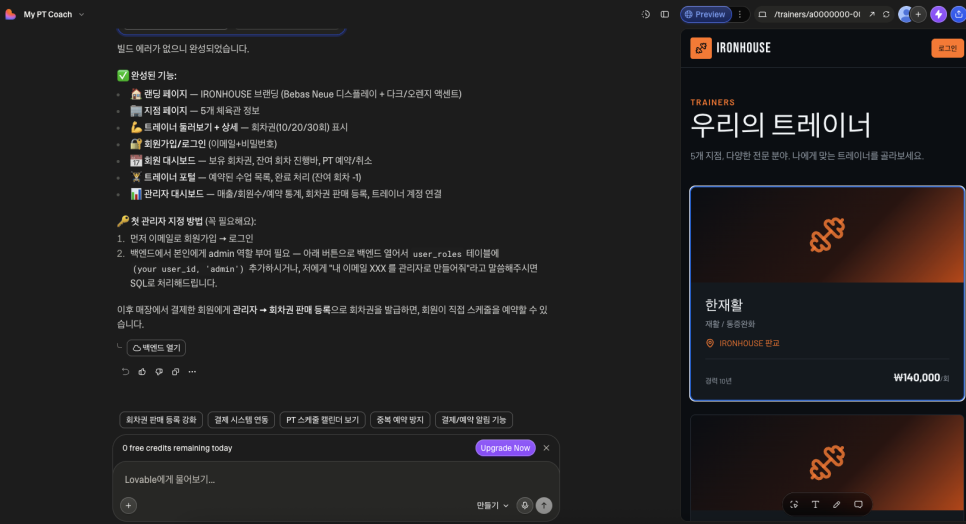
V1 – V147 (13,600 total hours of experiments)
Early on it was a mess. The design was ugly, the LLM would arbitrarily delete requested features, and the pipeline crashed constantly. Each run I’d add a new hypothesis and test it, improving bit by bit. A single run took 12 hours in the early days — and nothing was more deflating than finding the pipeline stalled on a trivial error. But I kept at it stubbornly. The most effective strategies were Scaffolding and Hard/Soft Gates. By late May, past v130, it started to get usable — for the first time it scored above 80% in final testing. We used it on a real contracted project and finished in about two weeks what used to take three months. (And even that was mostly comms and account setup; the actual code/design pipeline ran for about two days.) But past 80%, progress slowed. More experiments meant burning a lot of tokens, so the whole company applied to the Xiaomi MiMo program and pooled every token we could. Past V140 we began running two pipelines in parallel — feeding two PRDs through the same pipeline, or the same PRD through different models.
In the AI era, a developer feels less like an engineer and more like a scientist — constantly forming hypotheses, controlling variables, running experiments, and pulling lessons from the results.
If even a small operator like us has come this far, surely somewhere in the world a company already owns and runs a one-shot software factory. If every piece of software could be made in a day or two, like a t-shirt, what happens to this industry?
Potential — a global-expansion dev partner for founders going West.


See Other Blogs
View All
We Paused Every Project for Two Months to Bet the Agency on AI Native Software Agency, Part 1
Betting the Agency on Agentic AI, Part 2: Firing Half the Team, and a 39°C Flight to a Client
The 3 Stages of Becoming AI-Native: Grunt, Architect, and the One Who Designs Architects

What we learned after giving every employee a Claude Code account and forcing them to use it for 6 months
I Flew to LA to Be an FDE: 72 Hours Inside a US Client