{`What CC-analytics revealed, the two lessons that cost half the team, and an unpaid 72-hour FDE trip`}
Betting the Agency on Agentic AI, Part 2: Firing Half the Team, and a 39°C Flight to a Client
Lukas
Jun 4th 26
8 min Read
Continued from Part 1: We Paused Every Project for Two Months to Bet the Agency on Agentic AI.
The shock of actually looking at the team's Claude Code usage
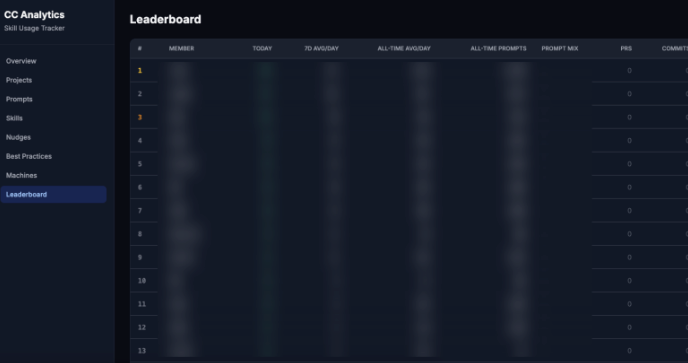
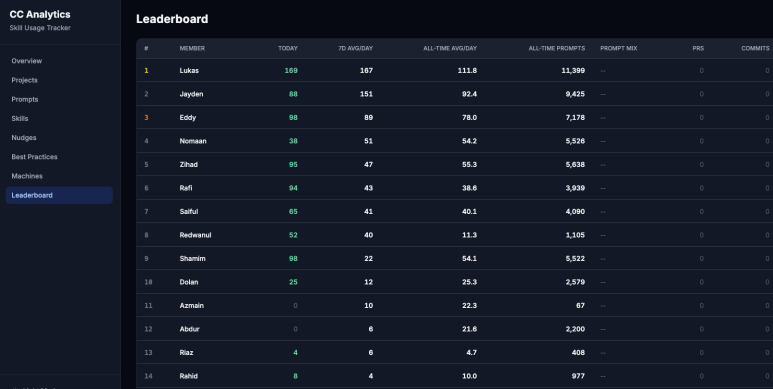
In January I finally looked at everyone's CC-analytics — and couldn't hide my shock. It also explained why individual engineers' grasp of Claude Code was so shallow. The average teammate was running fewer than 20 Claude Code prompts a day. Over a ~9-hour workday, that's 2-3 prompts an hour. I genuinely couldn't understand it. On our team, someone who actually catches the bug — who really gets the tool's potential — usually runs 150 to 300 prompts a day. Yet about 90% of the team sat under 20.
(There's a lot to say about which metrics matter when you're building an AI-native software team, but that's its own post. My biased answer: prompt count, the share of prompts that are questions, and how often the phrase "root cause" shows up.)
I tried everything to push usage up
To lift that sub-20 daily usage, I tried just about everything:
- Bonuses for the top of the CC-analytics leaderboard
- Company-wide per-team .claude setups to force usage
- Constant shout-outs for cases where manual work was turned into an automated skill
- Weekly live runs of real projects to demo how to use it well
I tried a lot, and the team barely moved. The 1:1s made no sense to me — every single one went, "I really do think AI will change this industry. And Lukas, your sessions help a lot. I'll work hard at it." I spent two genuinely painful months in that unbelievable gap. I'd done everything I could: as the founder I used it more than anyone, I personally rebuilt my own manual work into skills and workflows, and I gave the team plenty of time and material.
Two lessons from two painful months
A handful of teammates believed in the direction and followed like cavalry — but only about 10%. Two lessons from all of it have stayed with me:
- You cannot teach motivation.
- Don't trust words — trust actions.
Everyone talked as if they were all-in on agentic development, but only a few actually acted on it. (Those few are still the best users six months later.) For a long time I wavered between "if I can't change their behavior, we get left behind and die" and "their behavior isn't changing." I have an American friend, George, I turn to in hard moments, and he was blunt: "Cut them." His advice — from someone with 20+ more years of experience than me — boiled down to: "There are things in people you can change and things you can't, and this is one you can't." So I let go of 50% of the team.
A DM from a US client — and an "FDE" pitch
Then one day a DM came in from a US client: "Lukas, how are you? I know you've got your hands full with your second baby, but I'd love for you to take a look at our project. We've got this issue in our operations. Look at it when you get a chance."
Briefly: this is a company we've worked with for over two years, running a service that makes serious revenue — so any issue hits hard, and it's a high-difficulty project. Our team got it this far, but I didn't think we'd be working the traditional way ten years from now. So I wrote back:
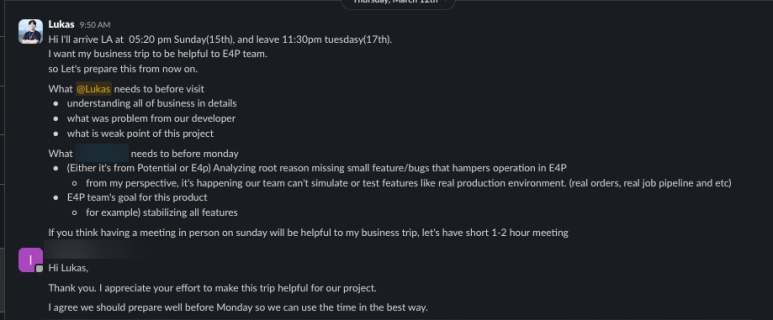
"Hey XXX — doing well? Have you heard of Claude Code? I've been going deep on it, and I have a proposal. What if I fly to your office, watch exactly how you work, and code right there beside you to fix or build what you need? Palantir and Silicon Valley companies call it an FDE — Forward Deployed Engineer — and they actually do it. There are obstacles, ha — I have to convince my wife and find a babysitter to cover the trip. I'll let you know if I make progress." (XXX is around my age with two kids, so we have a lot in common.)
Leaving a 100-day-old baby to get on a plane
As expected, my wife was furious — how could I travel and leave a 100-day-old baby? Honestly, that may have been the hardest part of the whole trip. I called my mother-in-law to cover one day, then my youngest brother for two more. Only then did my wife give the OK. If Potential ever succeeds, a huge share of the credit goes to my mother-in-law.
A 39°C fever and a thick stack of PRD
To make matters worse, the night before departure my fever spiked to 39°C. My wife told me not to go, but I bought the most expensive travel insurance I could and headed to Incheon airport. I billed the client nothing — not the flight, not the trip; it was entirely my own call. I had about 72 hours. It was the moment to put the Claude Code workflow I'd been sharpening in front of the market.
There were still plenty of obstacles. I mostly do sales and management now; I haven't shipped hands-on in a long time, so I didn't know this client's project well. Before leaving I built a PRD and printed it — and it was this thick. (A PRD is a document that describes a software project in as much detail as possible.)
I filmed a little documentary-style clip at the LA hotel thinking it'd be a nice memory someday — watching it now, it's pretty funny.
Only by drilling that stack of PRD on the flight, at 39°C, could I make real use of the precious 72 hours. One laptop, one stack of PRD, three sets of clothes — and off to Incheon. I've traveled all over: Southeast Asia, Bangladesh, Nepal, Afghanistan, Europe, Mexico — but never the US. As a kid from Ansan who always dreamed the American dream and swore he'd only go to the States "for business," this was that dream coming true — self-funded business, sure, but a beautiful moment.
To be continued. (I really did keep doing something, ha.)
Potential — the global-expansion development agency. The Korean agency that teams in Silicon Valley, London, Hong Kong, Dubai, and Tokyo call when they're going to market. → potentialai.com


See Other Blogs
View All
We Paused Every Project for Two Months to Bet the Agency on AI Native Software Agency, Part 1
The 3 Stages of Becoming AI-Native: Grunt, Architect, and the One Who Designs Architects

What we learned after giving every employee a Claude Code account and forcing them to use it for 6 months
I Flew to LA to Be an FDE: 72 Hours Inside a US Client

What If You Could Cut Outsourced Development 90× Faster and 15× Cheaper?