{`An agency only scales when every team meshes like gears. Here's how we broke ours down.`}
Why Agencies Struggle to Scale: The Marketing, Onboarding, and Dev Flywheel

Lukas
Jun 4th 26
9 min Read

I'd heard endlessly that agencies are hard to scale, and now that I'm living it, it feels even harder than the warnings suggested. The reason is that it only works when every single element meshes together perfectly, like gears in a machine. Let me break down how our three teams — marketing, onboarding, and development — interlock.
The marketing team
The marketing team has to produce quality content to make our existence known. It also has to find niche markets that need software, make them a compelling offer, and earn an interested reply.
Here's how we actually do it. There are countless real estate agents in Dubai. These agents have plenty of money, but the websites and software they use are often outdated. So our marketing team shows them the custom software and websites we could build for them, and makes an offer. The team's goal is to win as many positive replies from Dubai agents as possible.
The strategy above is the work of ANIK, whom I'm genuinely proud of.

The onboarding team
A Dubai real estate agent emails us: "Hello, is this Potential? I received this email and I'm interested — could we talk?"
From this point on, the onboarding team has to put care into every detail: email replies, chat replies, Google Meet calls. The team's goal is to deliver a proposal and quote the client will love, and to hear a "Yes."
The development team
There are two ways to earn ₩100M (~$72,500) a month. One is to raise our technical level high enough to win a single ₩100M project. Early on, I honestly thought that was the only way. But once I started doing the work myself, I realized there was another. The second way is to raise development speed. If we can compress a ₩3.3M (~$2,400) mini-project from a week down to a day, we can hit ₩100M by winning thirty of those ₩3.3M projects.
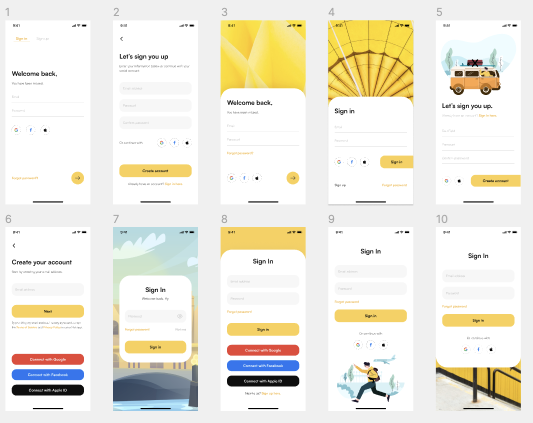
The development team's goals are complex, with a lot to attend to:
- Internal R&D to raise development speed
- Excellent designers
- Stronger internal manuals for easy handoff
- Studying new technologies
There's an enormous amount of ground to cover, but we're focused on the first one.
The module team: the power of building things in advance
For example, we build many versions of sign-up pages and features in advance, from design through to code. Designers design many pages ahead of time, and developers turn everything into modules — from simple UI like buttons and text to API calls and state management. (We have a Flutter package we use only internally.) That lets us cut development time and deliver software to clients at a more reasonable cost.
The module team described above is led by Abdur, whom I'm proud of (for the second time in this post).

There's a metric we're proud of: our onboarding-to-close rate is very high. When we send a quote to clients, most of them say yes. We're able to propose a reasonable price, and clients like that price. (A lower price doesn't mean lower quality, so don't misread it.) We plan to keep refining our modules so we can deliver software at an even more reasonable cost.
And an honest reckoning
I failed to hit this year's KPI. The personal goal I'd set was ₩100M a month. I could have done better and didn't, which leaves me with plenty of regret. There's only one way a not-so-smart boss wins in the market: be diligent, ask people smarter than you relentlessly, and actually listen to what they say.
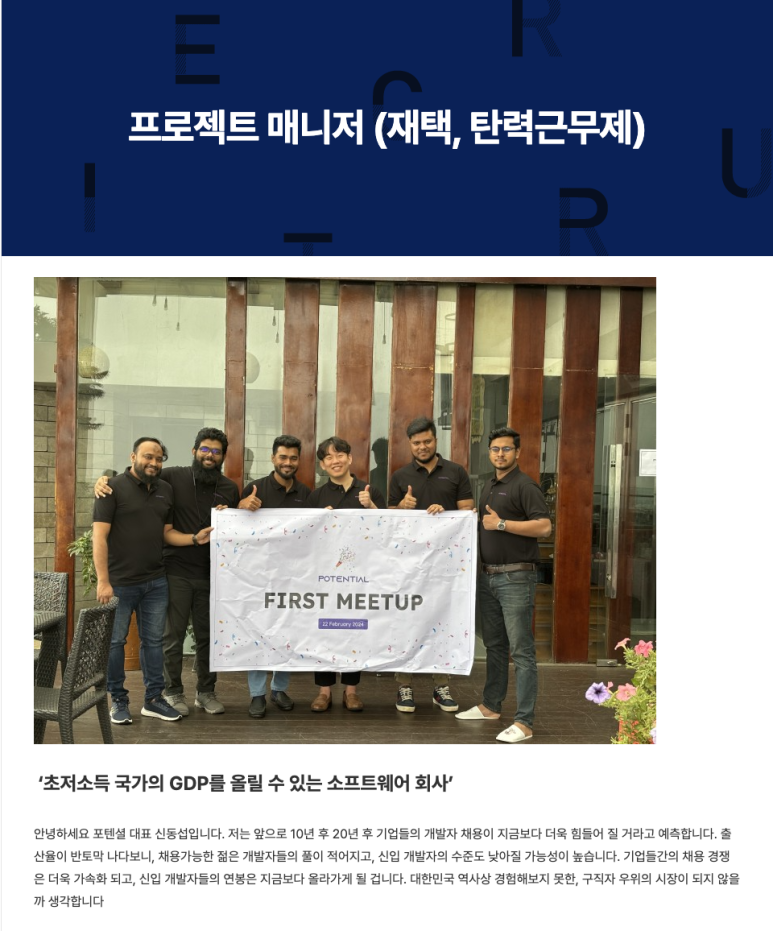
Potential (포텐셜) is a partner that designs the path to global markets alongside Korean and Asian founders. If you need software done right at a reasonable cost, reach out anytime.