{`After six years of bootstrapping, why the first real hire is the hardest wall a solo founder ever hits.`}
Why Am I So Bad at Hiring? A Bootstrapped Founder's Confession
Lukas
Jun 4th 26
4 min Read
It might look frustrating to watch a leader make foolish attempts day after day, but I want to write down as many of my trials and errors as I can. After six years of nothing but bootstrapping, here's why I hesitate so badly in front of my first real hire — and how the word "leverage" finally changed my mind.
The Feeling of Being Frantically Busy
Since I posted a job listing on JobKorea, a lot more people have been reading the blog. As always, March and April were dizzyingly busy. Not busy in a smart way — busy in a frantic, scrambling way — which gave me a strong sense that something was seriously off.
The client base is growing, but I haven't built the internal systems to handle this many clients. Unexpected bugs kept piling up, holes started opening in sales, and the internal systems were threadbare. Mulling over what the problem was, I called the mentor I always turn to. His answer was simple: "Hire a Korean." Other founders seem to do this so effortlessly — why is it so hard for me? I went to another founder, a woman I look up to. Her answer, again: "Grow a little Dongsub." Deep down, maybe I already knew the answer. So why was I hesitating?
Solopreneurship, the Inertia of Bootstrapping
For the last six years I've bootstrapped, nonstop. No government grants, no outside investment. As a result, the idea of growing while running a deficit doesn't compute for me — it's a frightening approach I can barely even imagine. For a bootstrapper, failing to hit break-even meant my family going hungry, which was the same as the business not being viable at all.
This approach has its pros and cons. The upside is you survive like a weed; the downside is that growth is correspondingly slow. Say there's about ₩50M (~$36K) sitting in the company account — money I earned with blood and sweat. That's enough to pay a teammate a full year's salary even if the company earns nothing at all. It's also 25 months of living expenses for my household. Or one Grandeur sedan. These thoughts tangle together and make hiring hard.
I knew I had to break through this wall to reach the next step, yet I couldn't bring myself to act. The way I see it, hiring isn't a simple transaction of company money for an employee's time. (Even more so if they have a family.) It's them betting the freshest years of their twenties and thirties on our company. When I ask myself, "Would I take a job at a company like ours, at this salary?" and even I can't easily say yes, I kept hesitating. (They say founders with the MBTI "F" type struggle to grow companies — maybe this is what they mean, ha.)
If You Could Make 1 + 1 Bigger Than 2 — Leverage
To overcome this inertia that's blocking my growth, there's a word I'm fixated on lately: leverage. The word carries an unsavory connotation of using or exploiting others, so I shied away from it too — but my thinking has changed a lot recently.
There's a designer we regularly ask for help. She does excellent work. Suppose a ₩20M (~$14.5K) project comes in. We could grind through the design ourselves without her help. In that case our revenue is 20M and the designer's is 0. Or, instead, we hand the design to her and take on another project we're good at. If we pay her ₩2M (~$1,450) per project, our revenue becomes ₩36M and the designer's becomes ₩4M. Everyone gains.
You Can Do Global Business Even If Your English Is Bad
You can do global business even if your English is bad. I know because I've done it. Recently I had a meeting with a UK software development firm. If I'd approached it defensively, the way I did as a rookie founder — "Are they trying to steal our company's information?" — no one would have gained anything. But the UK firm wants Korean clients, and we want UK clients. Both firms have enough experience to know exactly how much early portfolio work matters. So I made this proposal:
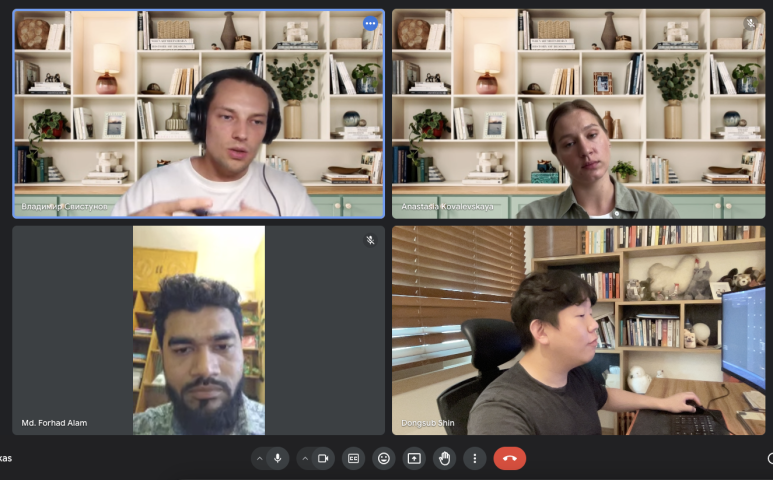
We'll connect you with Korean clients — no commission needed. In return, route the low-margin UK clients that come to you over to us. There's got to be a direction where we both win.
And so we agreed to work together.
What's the Direction Where Everyone Wins From a Hire?
To hire successfully, a founder needs a ready answer to: "Elsewhere you'd get 1, but with us you get 1 + something." The more tangible and less pie-in-the-sky, the better. What is our "something"? What can I offer? In the end, is it just salary?
Since I started hiring, I've met many people — many of them more capable than me. Our salary isn't attractive, so I felt genuinely sorry, but they applied anyway. Some offered to take nearly a 50% pay cut; some had been through the wringer at Samsung SDS. What can I promise these people? It's a night that makes my head spin.
Potential thinks about the global expansion of Korean and Asian founders — and works on building a better team ourselves, every day. If you're wrestling with similar questions, let's talk anytime.