{`Outsourcing shops say 'yes' to any scope — which is exactly why your MVP keeps getting bigger`}
What Happens When You Outsource Your MVP to a Dev Agency

Lukas
Jun 4th 26
12 min Read

This is a follow-up to "What happens when you hand a platform build to an agency that has never run a platform." This time the topic is the most common trap founders fall into when they outsource their MVP: the MVP that keeps getting bigger.
The MVP That Got Way Too Big
Roughly 90% of the projects that land on our desk are MVP (minimum viable product) requests. Why do so many MVP requests come to us specifically? Two reasons, I think:
- We ship fast (usually within 1-2 weeks)
- We define the MVP well
What does "defining the MVP well" actually mean? Because the MVPs that founders bring us are, more often than not, enormous.
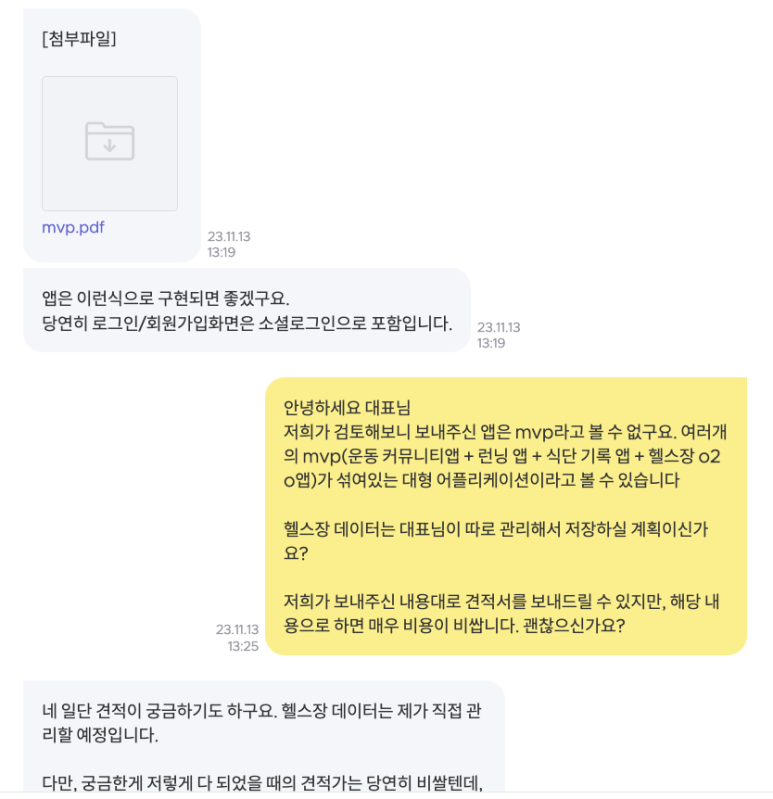
Running app + community app + gym O2O + meal-tracking app

Somewhere along the way the whole point of an MVP — ship the smallest possible thing to find out whether the market wants it — gets forgotten, and features start piling on. It feels too thin on its own, so they bolt on a community, then chat, then a rewards system. The founder above originally wanted a running-based rewards app, but ended up adding a community, meal tracking, and nearby-gym recommendations.
I understand the instinct — the more features, the more users will love it. But you have to do the exact opposite. Strip features down and down until you're focused on a single one. You might read this and think "that's not me," but it's only a matter of degree: every founder is weak to the temptation of adding just one more feature. Even Toss — a company famous for getting this right — once put chat into its app and later killed it.
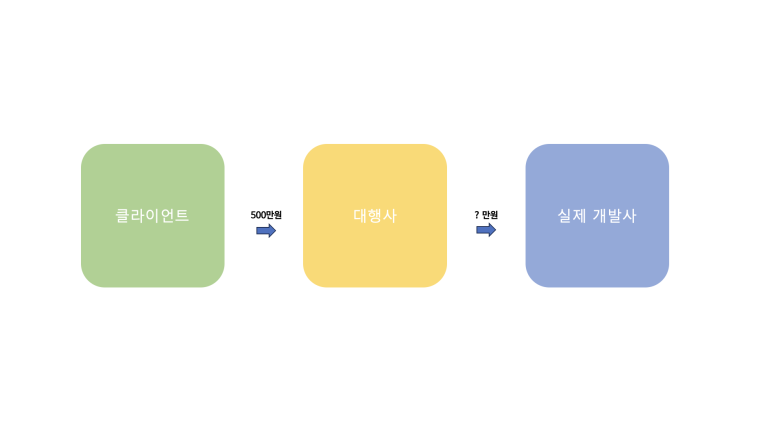
So who benefits when the MVP gets bigger? The outsourcing shop. Whether the MVP is big or small, whether the client's business succeeds or fails, the agency's job is simply to land the biggest possible contract and build what's asked. So no matter how bloated the requested MVP is, the answer is "sure, sounds great," followed by a fat contract and a long build.
How Small Should an MVP Actually Be?
Which raises the most important question: how small should you make it? The simplest answer I can give — cut everything, all the way down to the point where you're asking "wait, do I have to cut this too?"
Imagine going back ten years and building the very first food-delivery app.
- Cut the map feature?
- Cut reviews?
- Cut coupons?
- Integrate a payment gateway?
- Cut restaurant categories?
My answer to every one of these is no. Remove all the nice-to-haves and ship with just the one or two features you genuinely can't live without. In my view, a single flyer image per restaurant would do, skip payments entirely, and just wire up each restaurant's phone number — that alone functions perfectly well as an MVP. The goal of building an MVP right now isn't success; it's validation.
"But surely I need reviews…" "No. Cut them."
Founding a Company Is Like Baseball
I've always compared startups to baseball. The batter is the founder; the pitcher's ball is the market. Your first time at the plate, the pitch is so fast you can't even see it, and you swing and miss again and again. But the more times you step up, the better your eye gets — you start laying off the bad pitches, fouling some off. And somewhere around your 8th or 9th at-bat, you connect for a hit, or a home run.
In other words, the single most important thing in entrepreneurship is getting to the plate often — in startup terms, "failing small but continuously taking new swings with new products."
Say you have a budget of ₩20M (~$14.5K).
- One polished ₩20M attempt
- vs ten ₩2M (~$1.4K) attempts

Which one you bet on is the founder's call.
PS. An outsourcing shop will say "OK" to any MVP, big or small — take their yes with a grain of salt.
What Is an MVP?
It's an application built for the sole purpose of validating a business — a scout sent ahead to see what's there. You give up every other feature and focus on a single one, just to find out whether the business will land or not.
If you want to validate your idea in its smallest possible form, it starts with defining your MVP properly small. Potential is a development partner that helps Korean and Asian founders expand westward — and we start by thinking through the MVP definition with you. Reach out anytime.