{`Lessons from cold-requesting 30-minute meetings with South Asian founders — and from The Goal and The Leadership Pipeline.`}
What the Best Global CEOs Actually Do

Lukas
Jun 4th 26
9 min Read

Of everything I could do today, what's the highest-impact move? Lately, the answer is a 30-minute meeting with a global CEO. Here's what I've learned cold-requesting meetings with South Asian founders — plus two books, The Goal and The Leadership Pipeline.
I finally got some free time — maybe the first in eight months. Thanks to my mother-in-law and my wife giving me a break, I'm sitting in a café for the first time in ages. I read a lot, and thought a lot. I want to spend one hour of this (genuinely rare) time off writing down what's happened recently — following YR's advice to make as much content as I can.
A 100% acceptance rate, regardless of company size
I've started beginning each day with this question: of all the things I could do or choose today, what's the highest-impact one? There are several candidates, but lately I mostly do 30-minute meetings with CEOs.
Literally — I reach out to CEOs and request a meeting. Can you spare 30 minutes? I've tried it various ways: Google Meet, in-person office visits. And remarkably, regardless of company size, I've had a 100% acceptance rate so far. I tend to reach out to South Asian founders (India, Bangladesh). Maybe it's that a Korean is a novelty, and maybe it's that most other founders hate the idea of approaching hat-in-hand, so few people do this.
The world is full of formidable founders. Nasir, who built his design agency to ₩10B (~$7.2M) in two years. Divij, an Indian founder in his 20s who hit $50K MRR six months after launching. Rasiul, who runs the "Naver of Bangladesh" with 800+ Bangladeshi developers.
What the masters have in common — they share knowledge freely

The thing these people had in common: they were sincere about sharing their knowledge.
- Nasir told me the US market isn't necessarily the answer — "we're focused on the Middle East; Lukas, why don't you take a proper second look at the Korean market?"
- Raisul spent a full hour, whiteboard and all, teaching me how an agency can scale up.
- Divij told me the agency business grows bigger by narrowing the market, not widening it.
The world is wide and the masters are many — and just doing business in Korea, with its relatively strong currency, made me reflect on how easy I have it. Naturally, India and Bangladesh have none of Korea's startup grants or TIPS-style programs; most people earn their dollars from a standing start.
A side note from these meetings: asking for help is a great way to start a relationship. I think it's from Dale Carnegie's How to Win Friends and Influence People — every human has a desire to feel important. Whether it's a homeless man at Seoul Station or a global CEO, the question "tell me the best and worst decisions of your life" has the power to make the other person feel important. (And honestly, I do think of them as important.)
High-impact book 1 — The Goal
It's such a shame I only read this book now. Beyond the truth it contains, the way it makes that truth easy for an ordinary person to grasp is genuinely admirable. Here's one example from its story.
There's an army unit. Say the soldiers march at an average speed of 3 km/h. If they have to march a total of 30 km, when does the unit reach its destination?

Since I've posed it as a problem, you can probably guess the simple answer "10 hours" isn't it. The members average 3 km/h, so let's assume they walk somewhere between 2 km/h and 4 km/h. The lead soldier probably arrives in 10 hours. But what about the second, the third, the very last? Anyone who's actually marched in a unit knows the column stretches out — no matter who ends up at the back.
For example:
- 1st (4 km/h)
- 2nd (3.5 km/h)
- 3rd (3 km/h)
- 4th (1.9 km/h)
- ...
- Last (0.5 km/h)
Unless you overtake the column, you can't move faster than the person in front of you. What this means is that the speed of the very last person determines the speed of the whole team. And to raise the team's overall speed, you have to figure out how to raise the slowest person's speed. There are several ways:
- Walk two columns abreast instead of single file.
- Move the slowest person to the front.
- Tether front and back so everyone moves at a set pace.
The Goal introduces the bottleneck phenomenon that arises from statistical fluctuation (2–4 km/h) and dependent events (you can't go faster than the person ahead). And it frames the CEO's most important role as solving that bottleneck.
Apply this to our company. Objectively, our weakest team is the backend team. Which means: no matter how well the frontend team performs, if we don't solve the backend team's API-development speed, the whole team's project speed stays put. You have to define the bottleneck and fix it.
Basketball business vs. soccer business
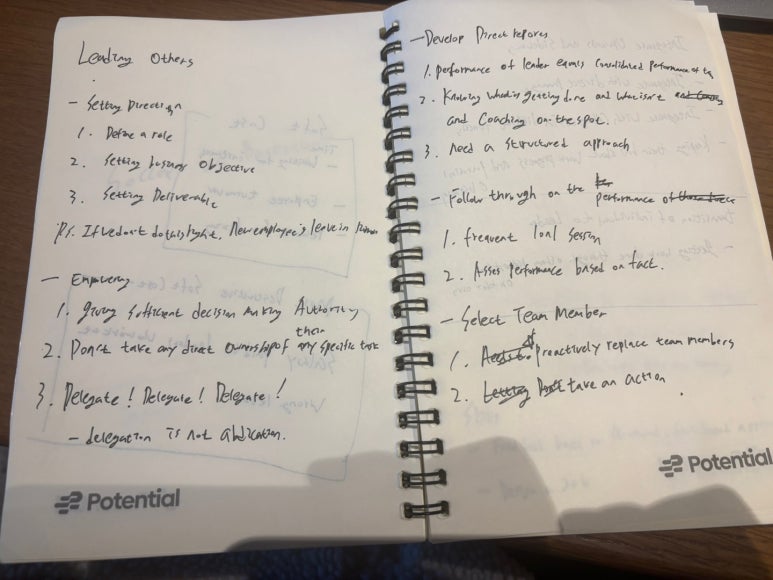
Another book I'm reading (The Leadership Pipeline) has a point worth connecting here. The author says the world's businesses can be split into two types: basketball businesses and soccer businesses.
Basketball
- Scoring is high, around 90 points.
- It's common for a single player to take the ball coast-to-coast and score themselves.
- The top 2–3 players who can manufacture a basket no matter how they're defended are crucial.
- Having 1–3 star players on the team matters enormously.
Soccer
- Scoring is low, 2–3 goals.
- A goal takes 7–8 passes to set up.
- The floor — the level of your weakest player — is what matters.
For the SaaS industry, where a handful of people create huge impact, the basketball star-player approach fits. But for a company like ours, the soccer approach is right. There are many similar analogies — "a chain is only as strong as its weakest link," and so on.
High-impact book 2 — The Leadership Pipeline
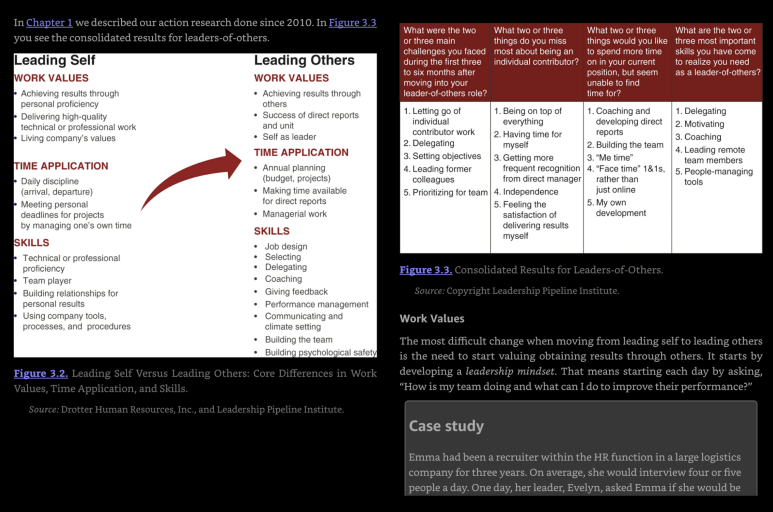
Remarkably, two masters recommended this book to me at the same time. One was Raisul, mentioned above; the other is a friend who practically carries our company. Both told me I really needed this book, so I read it — and it's teaching me exactly what I need right now. I think it's the first book I've ever read while taking notes.
I'm reading slowly because I'm chewing on every bit. But in the simplest terms, it explains leadership across several layers:
- Leader of Self
- Leader of Others
- Leader of Leaders
- Leader of Function
- Leader of Business
It describes the difficulty of moving leadership from one layer to the next, and shows that each stage needs a systematic approach. Because it's exactly what I'm struggling with, it went straight in. I'll actually experiment with what the book lays out and share more of what I learn.
I have many more books to recommend, but the post is getting long, so I'll stop here.
Potential (포텐셜) is the global-expansion development partner for Korean and Asian founders building toward Western markets. We fold what we learn from the world's best operators back into how we run our own team.